Byline: Founder, Infection Studio
Published: 2026-10-03 · Last updated: 2026-10-03
AI in animation production now covers some of the slowest steps: in-betweening, rendering, lip-sync, and localization all run faster with AI in the pipeline. What AI has not taken over is the part that makes an animated piece actually work: the story, the timing of a character’s performance, and the hundreds of small judgment calls that separate craft from output. If your team is trying to figure out what AI actually changes in animation production, and what it does not, here is a plain-spoken look.
Table of contents
- Does AI replace animation studios?
- What AI actually handles well today
- What AI still cannot do
- How a craft-led studio uses AI without losing quality
- What to look for when you’re evaluating an animation partner
- FAQ
- Where this leaves your team
Does AI replace animation studios?
No: AI changes how animation gets produced, not who makes the creative decisions that decide whether it is good. A studio that uses AI well still needs an animator to direct performance, a writer to shape the story, and a director to decide what the audience should feel in a given moment. AI shortens the mechanical steps between those decisions. It does not make the decisions.
This matters for your team if you are choosing between a traditional studio, an AI-only vendor, and doing it in-house. The honest comparison is not “AI versus human.” It is “which parts of this project actually need a human, and which parts are repetitive enough that AI handles them just as well.”
What AI actually handles well today
AI now speeds up four repetitive stages of animation production: in-betweening, rendering, lip-sync, and localization. The platforms people already use are moving the same way. Meta says its AI “translates, dubs, and lip syncs reels on Facebook and Instagram,” with an optional lip-sync that “syncs the translated audio to the creator’s mouth’s movements” (Meta, October 9, 2025).
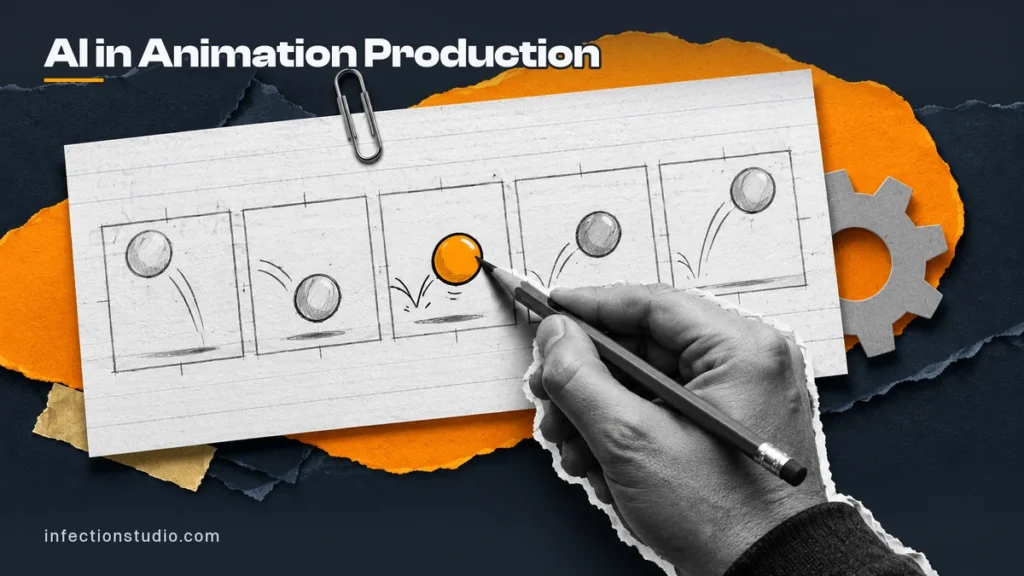
In-betweening. Traditionally, an animator draws key poses, then an assistant (or the same animator) fills in the frames between them. AI tools can now generate a solid first pass of those in-between frames, which an animator then reviews and corrects. The time saved shows up in production schedules, not in the creative brief.
Lip-sync. Matching mouth shapes to dialogue used to be one of the more tedious frame-by-frame tasks on a project. AI-assisted lip-sync now adapts a character’s mouth shapes to the sounds of the target language, giving an animator a usable first pass to refine for timing and expression.
Localization. When a brand needs the same animated piece adapted for multiple markets and languages, AI speeds up the repetitive parts of that adaptation (re-timing dialogue, adjusting on-screen text, resyncing mouth movement). The studio then spends its time on what actually changes market to market, like tone and cultural fit.
The same shift is visible at the top of the industry. In July 2025, Netflix co-CEO Ted Sarandos said generative AI helped the team behind the Argentine series The Eternaut finish a building-collapse sequence 10 times faster than with traditional special effects tools (Vice, July 18, 2025). The speed gain landed on one mechanical, effects-heavy shot. The story around it was still written and directed by people.
What AI still cannot do
AI cannot write your story. It cannot decide that a character should pause half a second longer before delivering a line, or that a scene needs to feel quieter than the script implies. Those are craft decisions, and craft decisions are what a client is actually paying a studio for.
Netflix’s co-CEO frames it the same way. Ted Sarandos called generative AI “an incredible opportunity to help creators make films and series better, not just cheaper” (IBC, July 23, 2025). The tool helps creators. It does not replace them. AI also cannot make the brand judgment calls: whether an illustration style fits a brand’s existing visual identity, whether a joke lands for a specific audience, or whether a 30-second spot needs to open on a wide shot or a close-up. These are taste and story problems, which is a different category of work entirely.
“AI-only” production has a ceiling for the same reason. A pipeline with no human directing the craft decisions tends to produce animation that moves correctly but does not feel like anything. It is technically finished and creatively empty, which is the opposite of what a brand commissioning animation usually wants.
How a craft-led studio uses AI without losing quality
A craft-led studio uses AI only where it saves time without touching a decision that needs a human. A simple way to sort that:
- Good fit for AI: in-betweening, rendering, lip-sync passes, localization re-timing, rough draft generation the animator will rework anyway.
- Not a good fit for AI: story structure, character performance direction, final craft polish, brand-fit judgment calls, client-facing creative decisions.
A craft-led studio treats AI the way it treated earlier production tools: it removes friction from the parts of the job that were never the creative part to begin with. The animator’s time moves to the work that decides whether a piece is good.
The difference between “AI-driven” production (where AI is the pitch) and AI used as one tool inside a craft-led process (where craft is still the pitch, and AI is how the studio gets there faster) is who owns the creative decisions. Infection Studio’s 2D animation and explainer video work sits in the second category: AI is part of the pipeline, not the positioning.
What to look for when you’re evaluating an animation partner
The fastest way to evaluate an animation partner on AI is to ask three questions, each with a clear right answer:
- Who directs the creative decisions on my project? A good partner names a specific person (an animator, writer, or director) who owns story, performance, and final craft calls, separate from whoever operates the AI tools. If no one owns those decisions, AI is running the project instead of assisting it.
- How are AI-assisted passes reviewed? Every in-betweening, lip-sync, or localization pass should go through a human review and revision step before anything ships. In our experience, unreviewed AI output is where most quality problems in AI-assisted animation show up.
- Can you show finished work, not just a process demo? A workflow demo proves the pipeline runs, while finished projects prove the output is good. Ask for completed work you can judge on its own merits, like the projects in Infection Studio’s portfolio.
If a vendor cannot clearly explain which parts of their process are AI-assisted and which parts are human-directed craft, that is worth a follow-up question before you sign anything. The same three questions work if you are comparing partners for corporate animation video production or weighing animation outsourcing for a longer pipeline.
FAQ
Will AI replace animation studios?
No. AI is taking over repetitive production steps like in-betweening, rendering, lip-sync, and localization, but story, performance direction, and brand-fit judgment calls still need a human. Studios that use AI well are faster, not obsolete.
What parts of animation production does AI handle well today?
AI currently handles in-betweening (filling frames between key poses), rendering, lip-sync matching, and the repetitive parts of localizing a piece for different markets and languages. Animators still review and refine this output.
How much faster is AI-assisted animation production?
The best-known example is a building-collapse sequence in Netflix’s The Eternaut, which Netflix co-CEO Ted Sarandos said was finished 10 times faster than with traditional effects tools. Gains like that apply to mechanical steps, not to story or direction, so in our view overall project timelines shrink less than the headline number suggests.
What can’t AI do in animation production?
AI cannot write a story, direct a character’s performance, or make brand and taste judgment calls, such as whether a visual style fits a brand’s identity or whether a scene’s pacing feels right. Those decisions stay with the creative team.
Does using AI make animation lower quality?
Not by itself. Quality drops when AI output goes unreviewed, not because AI was used. A studio that treats AI-assisted passes as a rough draft, then applies craft judgment on top, keeps quality intact while gaining speed.
How does Infection Studio use AI in its process?
AI is used for the repetitive, mechanical stages of production, such as in-betweening and lip-sync first passes, while animators and directors keep control of story, performance, and final craft decisions. AI speeds up the process; it does not set the creative direction.
What should I ask an animation vendor about their use of AI?
Ask who directs the creative decisions on your project, how AI-assisted work is reviewed, and whether they can show finished results rather than just a process demo. A vendor that cannot separate AI-assisted steps from human-directed craft is worth a follow-up question.
Where this leaves your team
AI now handles in-betweening, rendering, lip-sync, and localization, with at least one widely reported 10x speedup on a single effects shot. It does not handle story, performance direction, or the brand-fit judgment calls that decide whether a finished piece connects with an audience. That split, not “AI versus human,” is what determines whether a studio can move faster without losing craft.
Infection Studio has made animation since 2014, with 1,000+ videos for 110+ clients and partners, and uses AI inside that craft process rather than in place of it. If your team is scoping a project, browse our client work or talk to us about which parts of your project benefit from AI-assisted production and which need a director’s eye from day one.
Suka karya & insight kami? Follow kami di Google.Like our work & insights? Follow us on Google.
Tambahkan ke Sumber PilihanAdd to Preferred Source


